

You ask Claude for a client reply.
It comes back close.
Then you fix it by hand.
This issue fixes that.
You will write what "done" looks like before Claude starts.
Then you check the draft against it, line by line.
By the end of this issue you will be able to judge whether a draft does its job.
Here is the map:
Write the finish line first.
Put the finish line in the prompt.
Read the draft.
Check it against the finish line.
Fix only what failed.

New here? Welcome. Someone sent you this? Thank them, then subscribe so the next one lands in your inbox.
Why "close" keeps happening
Anthropic's own prompting guide says it plainly:
"Think of Claude as a brilliant but new employee who lacks context on your norms and workflows. The more precisely you explain what you want, the better the result."
A new employee also needs to know when the job is finished.
Anthropic's guide covers that too:
"Be specific about the desired output format and constraints."
That is a finish line.
It is a short list of things you can see in the draft.
Each one is a yes or a no.
One client question, start to finish
Illustration: the client, her numbers and the drafts below are made up to show the method.
A client, Maria, runs a small bookkeeping firm.
She emails you: "Should I raise my prices in January?"
Step 1. Write the finish line first
Before Claude writes a word, decide what a sendable reply has.
Mine for Maria:
The first line answers yes or no.
It names the one number she should check before deciding.
It gives one next step she can do this week.
It is under 120 words.
Every item is something you can point to.
"Sounds professional" is not on the list.
You cannot point to it.
Step 2. Put the finish line in the prompt
Maria runs a 4-person bookkeeping firm. She has been my client for two years.
She asked: "Should I raise my prices in January?"
Her rates have not changed in two years, and she is booked through March.
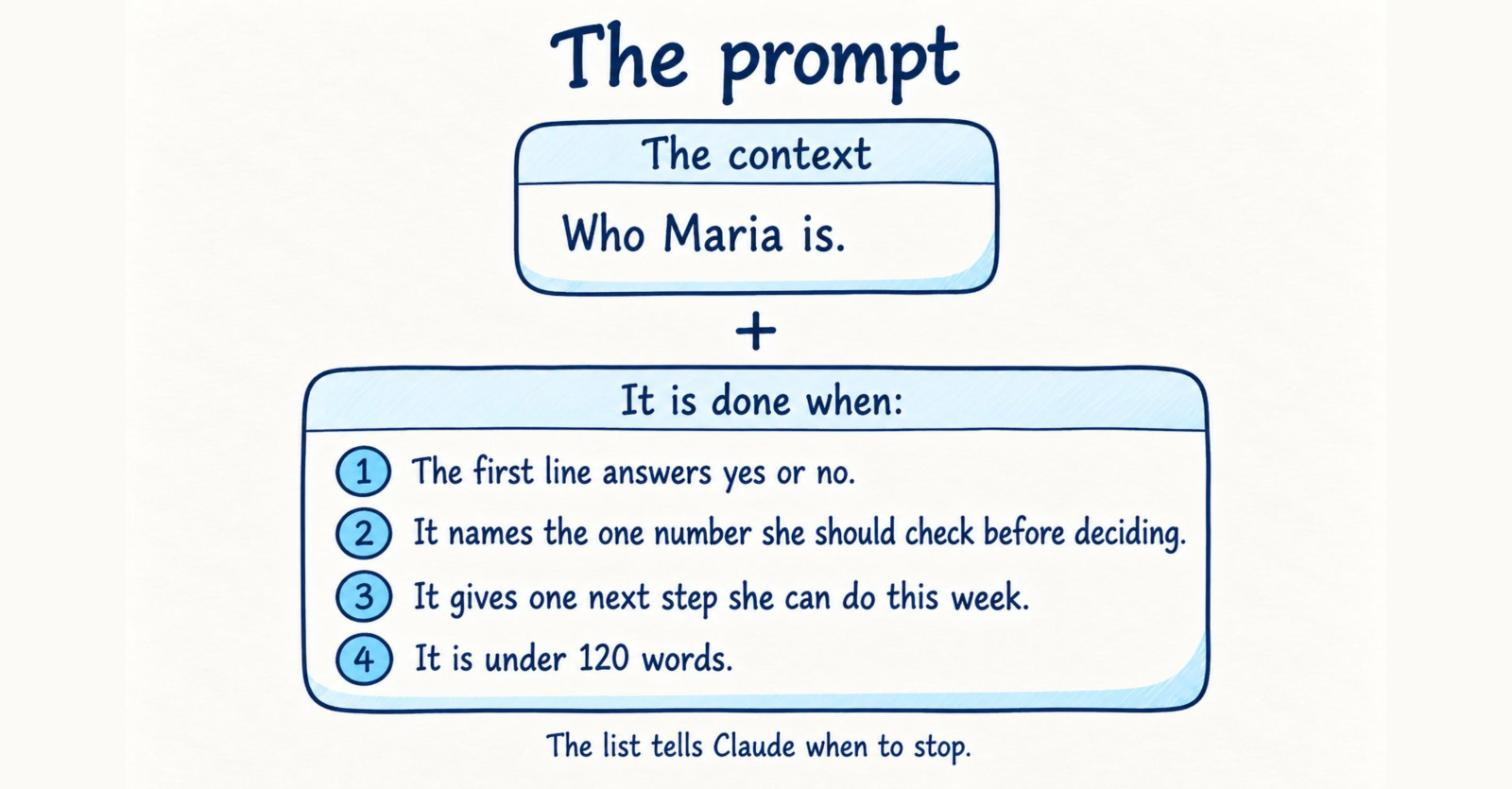
Write my reply. It is done when:
1. The first line answers yes or no.
2. It names the one number she should check before deciding.
3. It gives one next step she can do this week.
4. It is under 120 words.
The context tells Claude who Maria is.
The list tells Claude when to stop.
Step 3. Read the draft
Illustrative first draft.
Hi Maria, great question. Pricing is one of the biggest levers a firm has.
Given that you're booked through March, there's a strong case for an increase.
Check your utilization: how many billable hours you fill each week.
Next step: list your five biggest clients and their current rates this week.
It reads well.
The test is the finish line.
Step 4. Check it against the finish line
Open a fresh chat.
Paste the finish line and the draft.
Ask:
For each item, answer yes or no.
For every yes, quote the line in the draft that proves it.
The check came back:
First line answers yes or no: No. The first line is "great question."
Names one number: Yes. "Check your utilization."
One next step this week: Yes. "List your five biggest clients."
Under 120 words: Yes.

One item failed.
Now you know exactly which one.
Give the fresh chat only the list and the draft.
It only sees the list and the words.
Step 5. Fix only what failed
Do not ask for a new draft.
Ask for one change:
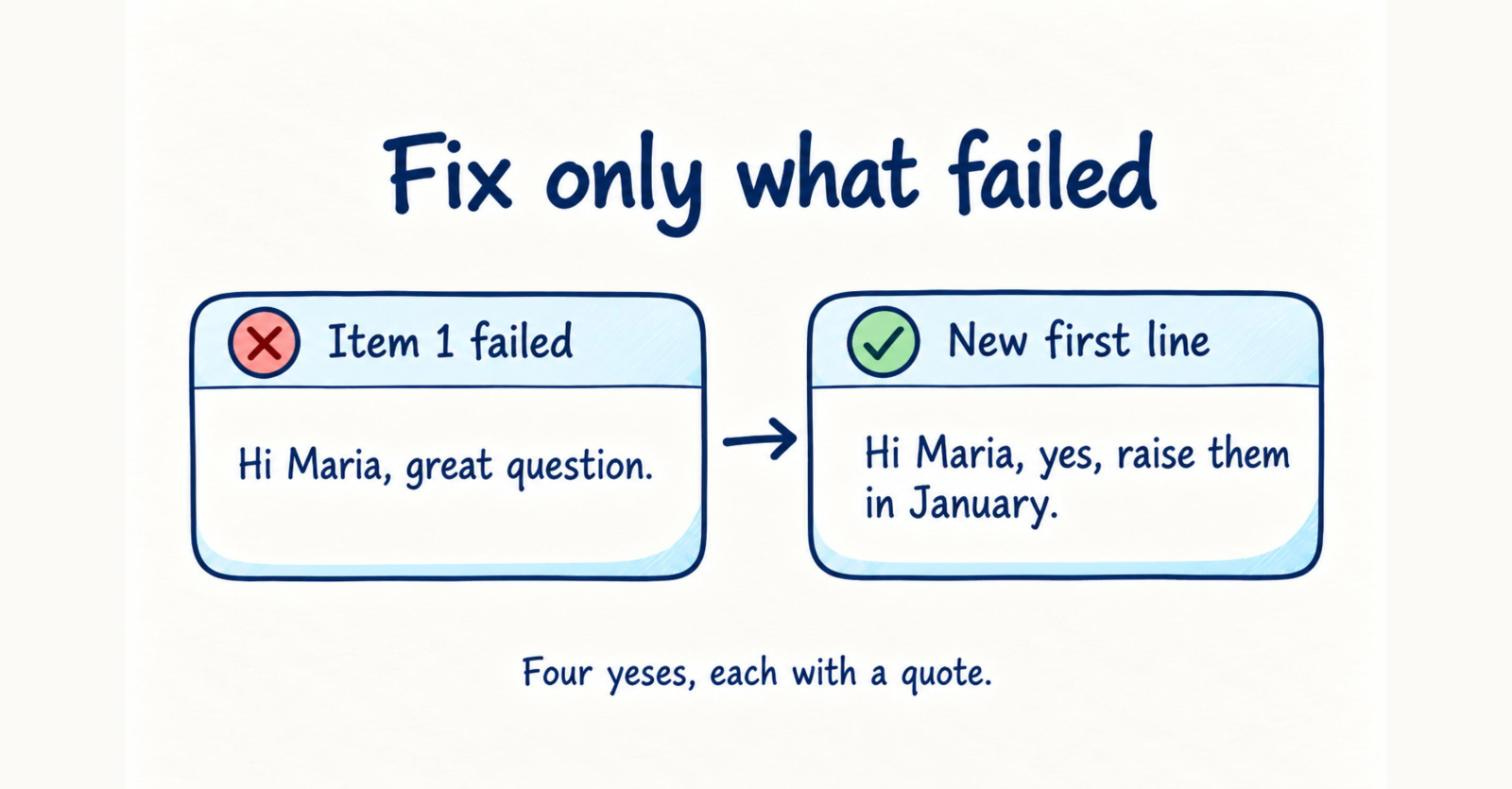
Item 1 failed. Rewrite only the first line so it answers yes or no. Keep everything else.
The new first line:
Hi Maria, yes, raise them in January.
Run the check again.
Four yeses, each with a quote.
Now it is sendable.
Lock the answer in
Once a reply passes, you want Claude to treat it as settled.
Anthropic notes a pattern in multi-turn chat.
Claude Opus 5.5 "sometimes goes back over an earlier answer while it thinks about a new message, even a short follow-up."
For that case, Anthropic wrote two sentences to add at the end of a chat system prompt.
They tell Claude to treat earlier answers as done unless you ask about them or point out a problem.
The instructions are intended to keep Claude focused on your follow-up instead of revisiting the answer you already approved.
I put the two sentences in a free guide, ready to copy, with where to paste them.
Get the 2 sentences for Claude's instructions:
Enter your email
Confirm, and the guide arrives
Where this falls short
The check is only as good as the list.
A vague item gets a vague answer.
Write items you can point to, or the check has nothing to grab.
A fresh-chat checker can still be wrong.
That is why every yes comes with a quote.
Read the quotes yourself before you send.
Some things stay your call.
Tone and taste cannot be pointed to in a line.
Keep them off the list and judge them yourself.
The 2 sentences have one job.
They are Anthropic's suggestion for one behavior: treating earlier answers as settled.
They are not a quality guarantee.
Maria is an illustration.
The example shows the method.
It is not a test result.
The finish line, on one card
Use this for any draft that matters:
Write 3 to 5 things a finished draft must have.
Make each one something you can point to.
Put the list in the prompt, after the context.
Check the draft in a fresh chat: yes or no, with a quote.
Fix only the items that failed.

Recap
Write the finish line first: 3 to 5 items, each one you can point to.
Put it in the prompt: context first, then "It is done when."
Read the draft: reading well is not the same as passing.
Check it in a fresh chat: yes or no, with a quote for every yes.
Fix only what failed: one change, then check again.
Where I stand
The quotes in this issue come from Anthropic's prompting docs, read on file 2026-10-21.
The yes/no check is the same one my Friday post teaches.
Nobody pays me to say any of it.
Leverage over hustle. This week: give one draft a finish line before you ask for it.
Eric
If this issue placed you, send it to one operator a rung below you. You will be the reason they climb.
PS:
Free Resources: ericmelillo.com/resources
Online Courses: ericmelillo.com/courses
Book a 1:1 Strategy Call: ericmelillo.com/book-call